
Weekly Market Commentary
June 1st, 2026
Week in Review
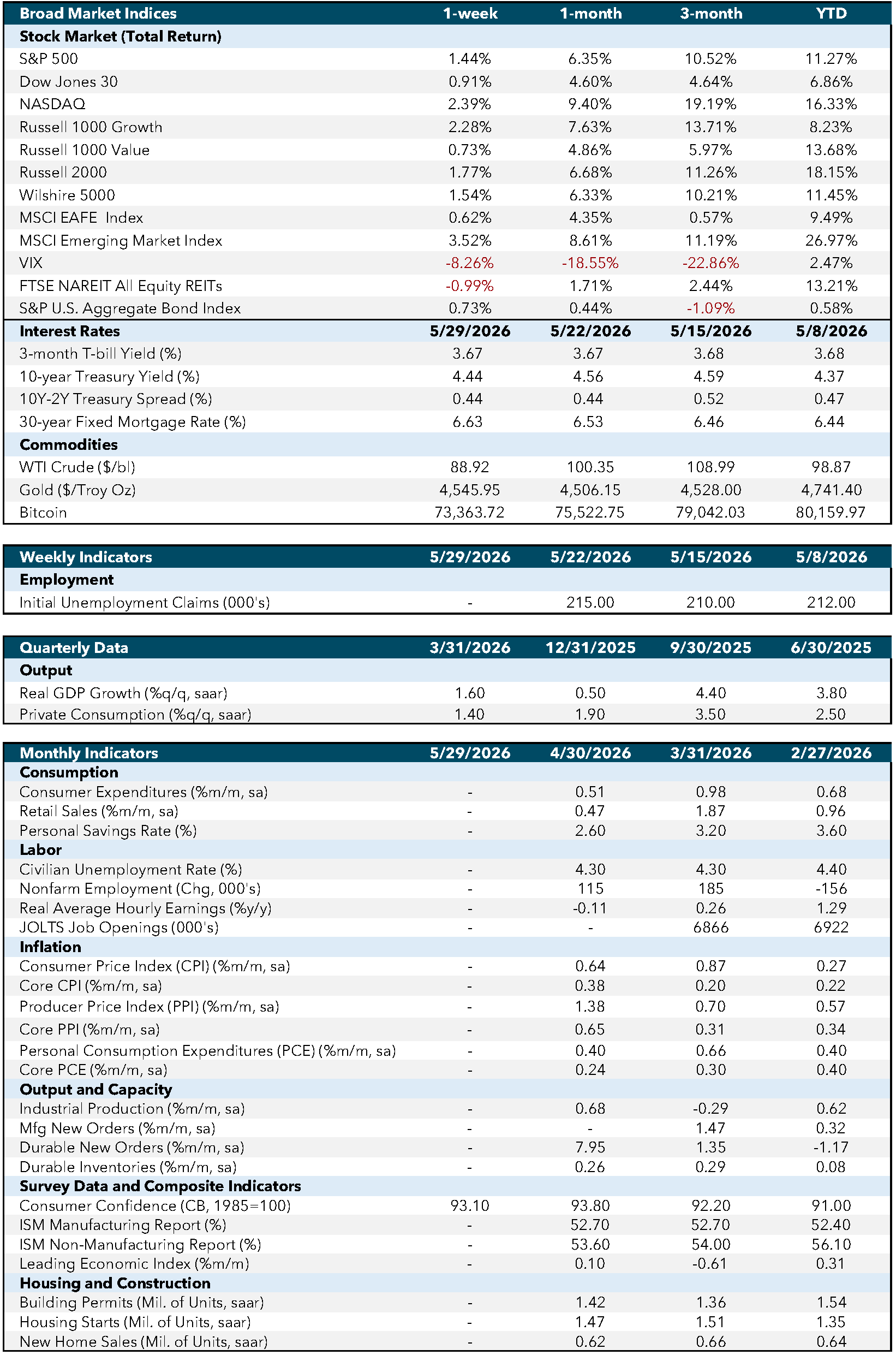
The latest round of data releases provided a more nuanced picture of the economy, highlighting a continued tension between moderating growth, persistent inflation pressures, and pockets of strength across key sectors.
The Consumer Confidence reading for May came in at 93.1, representing a slight decline from the prior month. While the headline softened modestly, the details were more balanced, with weaker views on current conditions offset by a small improvement in expectations. Overall, the data suggests the consumer remains in relatively solid shape, though signs of caution are beginning to emerge as higher prices weigh on sentiment.
The April New Home Sales release highlighted continued challenges in the housing sector. Sales fell 6.2% month-over-month to a 622,000 annualized pace, missing expectations and reversing some prior momentum. Also, housing inventories rose as elevated mortgage rates and affordability pressures continue to limit buyer activity. This dynamic suggests that housing remains a relatively weak spot within the economic outlook in the near term.
Thursday brought key updates on growth and inflation. The second estimate of first-quarter GDP showed expansion at a 1.6% annualized rate, revised lower from the initial reading, indicating some moderation in consumer spending and investment. At the same time, Personal Consumption Expenditures (PCE) inflation remained elevated, with both headline and core readings well above the Fed’s target. This highlights persistent price pressures and continues to keep the policy outlook constrained.
Friday’s Chicago Purchasing Managers’ Index (PMI) for May was a clear bright spot, rising to 62.7 from 49.2 in April. This sharp rebound, the strongest reading in over four years, points to a meaningful reacceleration in regional business activity and manufacturing momentum.
Meanwhile, crude oil inventories continued to draw down, with the latest Energy Information Administration (EIA) data showing a decline of approximately 3.3 million barrels for the week. This marks another week of tightening supply conditions, alongside declines in gasoline and distillate inventories. The ongoing draws reinforce a firm supply-demand backdrop in energy markets, helping to explain continued upward movement in fuel prices and the persistence of inflationary pressures feeding through to consumers.
Overall, the data reinforced a mixed but consistent narrative. Growth is moderating, particularly in rate-sensitive sectors, while inflation remains elevated. At the same time, pockets of strength, especially in manufacturing, suggest that economic expansion remains intact, leaving the outlook dependent on how these crosscurrents evolve.
Economic and Capital Markets Dashboard
Week Ahead…

Looking ahead, the first full week of June features several key data releases that will help shape the near-term economic narrative, particularly around activity trends and labor market conditions.
Monday will bring the ISM Manufacturing PMI, which has recently pointed to steady expansion in the industrial sector. This release will serve as an important gauge of whether that momentum is continuing to hold, especially as input costs remain elevated and broader growth shows signs of moderation.
On Wednesday, attention will turn to the labor market with the ADP Employment report, offering an early look at private sector hiring trends. This may help to set expectations for broader payroll growth and provide insight into underlying employment dynamics.
Another important midweek release is the May ISM Non-Manufacturing PMI, a critical indicator given the sector’s outsized role in overall economic activity. Recent data has suggested some moderation, so this release will be key in determining whether services demand is stabilizing or continuing to ease.
Thursday features weekly jobless claims, which remain a timely barometer of labor market conditions. Claims have generally stayed contained, and any notable increase would signal a potential shift in employment trends.
The week will end with the May Employment Situation report, including nonfarm payrolls, the unemployment rate, and wage growth. This release will be central in assessing the strength of the labor market and the broader sustainability of economic growth.
Overall, these releases will provide a comprehensive update on both activity and employment conditions, helping to refine the market’s view on growth durability and the path forward for monetary policy.
Economic Indicators:
- CPI: Consumer Price Index measures the average change in prices paid by consumers for goods and services over time. Source: Bureau of Labor Statistics.
- Core CPI: Core Consumer Price Index excludes food and energy prices to provide a clearer picture of long-term inflation trends. Source: Bureau of Labor Statistics.
- PPI: Producer Price Index measures the average change in selling prices received by domestic producers for their output. Source: Bureau of Labor Statistics.
- Core PPI: Core Producer Price Index excludes food and energy prices to provide a clearer picture of long-term inflation trends. Source: Bureau of Labor Statistics.
- PCE: Personal Consumption Expenditures measure the average change in prices paid by consumers for goods and services. Source: Bureau of Economic Analysis.
- Core PCE: Core Personal Consumption Expenditures exclude food and energy prices to provide a clearer picture of long-term inflation trends. Source: Bureau of Economic Analysis.
- Industrial Production: Measures the output of the industrial sector, including manufacturing, mining, and utilities. Source: Federal Reserve.
- Mfg New Orders: Measures the value of new orders placed with manufacturers for durable and non-durable goods. Source: Census Bureau.
- Durable New Orders: Measures the value of new orders placed with manufacturers of durable goods. Source: Census Bureau.
- Durable Inventories: Measures the value of inventories held by manufacturers for durable goods. Source: Census Bureau.
- Consumer Confidence (CB, 1985=100): Measures the degree of optimism that consumers feel about the overall state of the economy and their personal financial situation. Source: Conference Board.
- ISM Manufacturing Report: Measures the economic health of the manufacturing sector based on surveys of purchasing managers. Source: Institute for Supply Management.
- ISM Non-Manufacturing Report: Measures the economic health of the non-manufacturing sector based on surveys of purchasing managers. Source: Institute for Supply Management.
- Leading Economic Index: Measures overall economic activity and predicts future economic trends. Source: Conference Board.
- Building Permits (Mil. of Units, saar): Measures the number of new residential building permits issued. Source: Census Bureau.
- Housing Starts (Mil. of Units, saar): Measures the number of new residential construction projects that have begun. Source: Census Bureau.
- New Home Sales (Mil. of Units, saar): Measures the number of newly constructed homes sold. Source: Census Bureau.
- SA: Seasonally adjusted.
- SAAR: Seasonally adjusted annual rate.
Market Indices & Indicators:
- S&P 500: A market-capitalization-weighted index of 500 leading publicly traded companies in the U.S., widely regarded as one of the best gauges of large U.S. stocks and the stock market overall.
- Dow Jones 30: Also known as the Dow Jones Industrial Average, it tracks the share price performance of 30 large, publicly traded U.S. companies, serving as a barometer of the stock market and economy.
- NASDAQ: The world’s first electronic stock exchange, primarily listing technology giants and operating 29 markets globally.
- Russell 1000 Growth: Measures the performance of large-cap growth segment of the U.S. equity universe, including companies with higher price-to-book ratios and growth metrics.
- Russell 1000 Value: Measures the performance of large-cap value segment of the U.S. equity universe, including companies with lower price-to-book ratios and growth metrics.
- Russell 2000: A market index composed of 2,000 small-cap companies, widely used as a benchmark for small-cap mutual funds.
- Wilshire 5000: A market-capitalization-weighted index capturing the performance of all American stocks actively traded in the U.S., representing the broadest measure of the U.S. stock market.
- MSCI EAFE Index: An equity index capturing large and mid-cap representation across developed markets countries around the world, excluding the U.S. and Canada.
- MSCI Emerging Market Index: Captures large and mid-cap representation across emerging markets countries, covering approximately 85% of the free float-adjusted market capitalization in each country.
- VIX: The CBOE Volatility Index measures the market’s expectations for volatility over the coming 30 days, often referred to as the “fear gauge.”
- FTSE NAREIT All Equity REITs: Measures the performance of all publicly traded equity real estate investment trusts (REITs) listed in the U.S., excluding mortgage REITs.
- S&P U.S. Aggregate Bond Index: Represents the performance of the U.S. investment-grade bond market, including government, corporate, mortgage-backed, and asset-backed securities.
- 3-Month T-bill Yield (%): The yield on U.S. Treasury bills with a maturity of three months, reflecting short-term interest rates.
- 10-Year Treasury Yield (%): The yield on U.S. Treasury bonds with a maturity of ten years, reflecting long-term interest rates.
- 10Y-2Y Treasury Spread (%): The difference between the yields on 10-year and 2-year U.S. Treasury bonds, often used as an indicator of economic expectations.
- WTI Crude ($/bl): The price per barrel of West Texas Intermediate crude oil, a benchmark for U.S. oil prices.
- Gold ($/Troy Oz): The price per troy ounce of gold, a standard measure for gold prices.
- Bitcoin: A decentralized digital currency without a central bank or single administrator, which can be sent from user to user on the peer-to-peer bitcoin network.
This content was developed by Cambridge from sources believed to be reliable. This content is provided for informational purposes only and should not be construed or acted upon as individualized investment advice. It should not be considered a recommendation or solicitation. Information is subject to change. Any forward-looking statements are based on assumptions, may not materialize, and are subject to revision without notice. The information in this material is not intended as tax or legal advice.
Investing involves risk. Depending on the different types of investments there may be varying degrees of risk. Socially responsible investing does not guarantee any amount of success. Clients and prospective clients should be prepared to bear investment loss including loss of original principal. Indices mentioned are unmanaged and cannot be invested into directly. Past performance is not a guarantee of future results.
The Dow Jones Industrial Average (DJIA) is a price-weighted index composed of 30 widely traded blue-chip U.S. common stocks. The S&P 500 is a market-cap weighted index composed of the common stocks of 500 leading companies in leading industries of the U.S. economy. The NASDAQ Composite Index is a market-value weighted index of all common stocks listed on the NASDAQ stock exchange.
Securities offered through Cambridge Investment Research, Inc., a broker-dealer, member FINRA/SIPC, and investment advisory services offered through Cambridge Investment Research Advisors, Inc., a Registered Investment Adviser. Both are wholly-owned subsidiaries of Cambridge Investment Group, Inc. V.CIR.0626-1996